

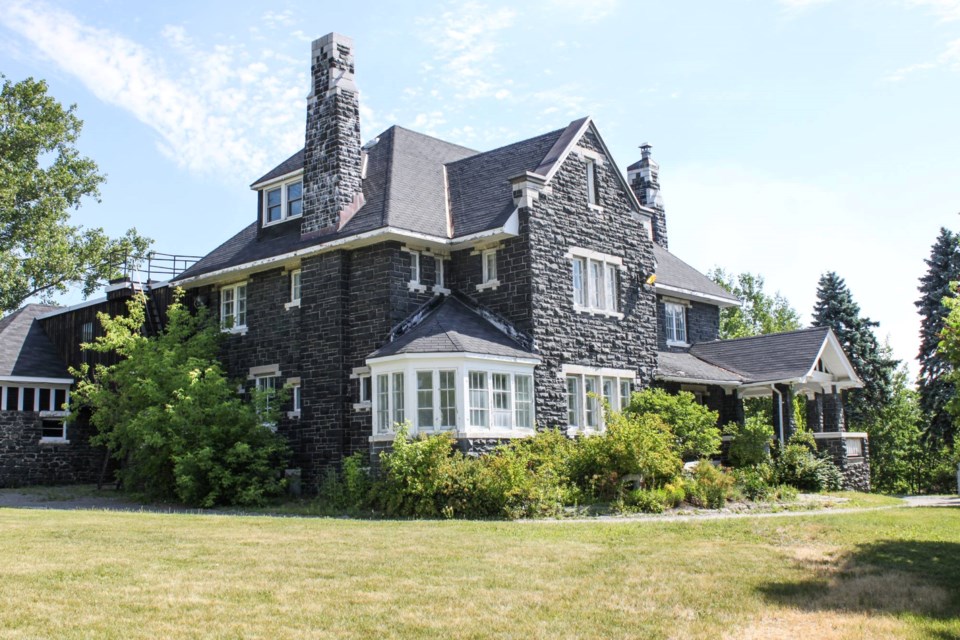
Having even been known to dress up as William Bell, the Sudbury lumber baron who donated the land that now makes up Bell Park, Sudbury artist Gordon Drysdale is an avid proponent of protecting and preserving Sudbury’s heritage.
He is reacting with concern after Laurentian University announced last month that it plans to sell Belrock, also known as the Bell Mansion.
The John Street building, which for many years has been occupied by the Art Gallery of Sudbury, was the home of pioneering couple William Bell and wife Katherine Bell.
The Bells moved to Sudbury in 1896, and Mr. Bell would go on to purchase controlling interest in the Spanish River Lumber Company, establishing operations along Lake Wanapitei. They built Belrock, their John Street home, in 1907.
The couple also purchased a large nearby tract of land along Lake Ramsey, and gifted it to the Town of Sudbury nearly 100 years ago, in 1926, with the purpose of it being turned into a park, which is now known as Bell Park.
The Bell Mansion is “too important a piece of architectural history in the city to go by the wayside,” said Drysdale.
He said he’s concerned that the building “is going to end up in the hands of someone who’s just looking at an opportunity and dollars rather than considering heritage.”
The Art Gallery of Sudbury has long had plans to move into Sudbury’s still yet-to-be-realized cultural hub.
Knowing that this was on the horizon, around 15 years ago, Drysdale spearheaded efforts to have the Bell Mansion restored and turned into a museum after the building was vacated.
There’s a Facebook group devoted to this effort entitled Friends of Belrock.
He and several other Sudburians we spoke to still think that’s what should happen to the historic site, saying it should be something akin to Craigdarroch Castle in Victoria, B.C. or the Copper King Mansion in Butte, Montana.
Drysdale said he thinks the building should be taken over by the City of Greater Sudbury. An ad hoc committee would have to be created to find out what’s needed in terms of repairs and restoration, and a plan created, he said.
The Bell Mansion has been closed since 2023 due to repair issues, with Laurentian deciding in October 2024 (although it only made that decision public in December) that it would sell the property, as it was too expensive to repair.
The building is a designated heritage site, meaning that it’s regulated by a municipal bylaw that lists heritage elements and attributes of the property that are to be preserved, and is protected from demolition or incompatible alterations to significant heritage features.
Drysdale said he finds the fact that the building has fallen into such disrepair to be “disgusting,” and is worried for the building’s integrity.
The situation with the Bell Mansion has also come to the attention of the heritage committee of the Kingsmount-Bell Park Community Action Network (CAN), which covers part of the City of Greater Sudbury’s Ward 10, in which Belrock is located.
Members of that committee would also like to see the building taken over by the city and turned into a museum.
“I see the Bell Mansion as an anchor to Bell Park, with Science North,” said heritage committee member Paul Haynes, adding that a combination of public and private money would be needed to make that happen.
Ruby Boileau, another member of the CAN heritage committee, is hoping that Laurentian might go directly to the city about the sale.

She said she’s glad Laurentian has finally “cleared the air” in terms of its intentions for the building, “because I really want to see that building fixed up before it deteriorates anymore.”
“I'm just waiting for the city to do the responsible thing, talk to the board of governors (at Laurentian) and put it back to the people of Sudbury, so we can use it as a green space and a heritage space,” Boileau said.
As the structure falls within his ward, Haynes said the CAN has been in contact with Ward 10 Coun. Fern Cormier on the situation. Sudbury.com has reached out to Cormier by phone and email, but he had not contacted us as of this article’s publication.
How did the Bell Mansion come to be in Laurentian’s hands?
Dieter Buse, a Laurentian University professor emeritus of history, said there were actually plans for a centennial project in the 1960s to turn the Bell Mansion into a museum.
This idea was abandoned in favour of creating the art gallery that eventually became known as the Art Gallery of Sudbury.
Following the death of William Bell in 1945 and Katherine Bell in 1954, the family home, property and most of the contents were left to the Memorial Hospital. Until a fire in 1955, the Bell Mansion building was used as a staff residence.
After the fire, the building remained in a sorry state until the Nickel Lodge of the Masonic Order undertook its preliminary renovations as a site for their headquarters.
Due to zoning problems, they were unable to proceed, and in 1966 the property was purchased by the Centennial Committee of the Chamber of Commerce.
It was this Centennial project that converted the building to its present usage. The centre was officially transferred to Laurentian University in 1968 (for a symbolic $1, said Buse) to be opened for the people of Sudbury.
“The spirit and intention of the gift to Laurentian was that Sudbury have a public museum or cultural centre,” said Buse, who said it should not be sold by LU for that reason.
“Laurentian has allowed the building to decay by neglect, which was definitely not the intention of those who had renovated it and gifted it,” he added.
He said the building was “held in trust” by the university to serve cultural purposes, “and it should remain in the public realm. Sudbury has museums on agriculture and railways, but no real one telling the full story from forestry to mining to regional centre.”
He’s hopeful that local mining companies could be convinced to donate money toward restoring the Bell Mansion as a museum.
Buse, an LU academic administrator in the 1990s who was assigned the Bell Mansion file, said he pushed for some money to be spent on the building at that time, but really, he had his plate full.
“Nobody at the university over 40 years really had time to deal (with it) properly, to handle the art gallery and the building,” Buse said. “So the result was negligence … the university has never taken the responsibility of the gift that it received.”
Heidi Ulrichsen is Sudbury.com’s assistant editor. She also covers education and the arts scene.