
For the last four months I’ve been driving carefully, cautiously, and conscious of my speed. It’s all Sunday driving on a Monday morning and not much of it of my own accord.
You see, I’ve drawn the short straw when it comes to the speed cameras recently installed at strategic points in the city. I’ve got to drive by two of them on my journey to work and back, one in a posted 40-km/h zone and the other in a posted 30 km/h zone. Both are in neighborhoods where they are doubling any fine incurred, so the penalty would be steep.
They’ll both be moved in a few weeks and at that time I’ll feel much like somebody who has completed their prescribed probation, with the skip in my step of one freshly emancipated from an unsympathetic and onerous form of surveillance. But I think I’ll also miss them, and I realize I say this as somebody who has so far fortunately slipped through their fine, fining net.
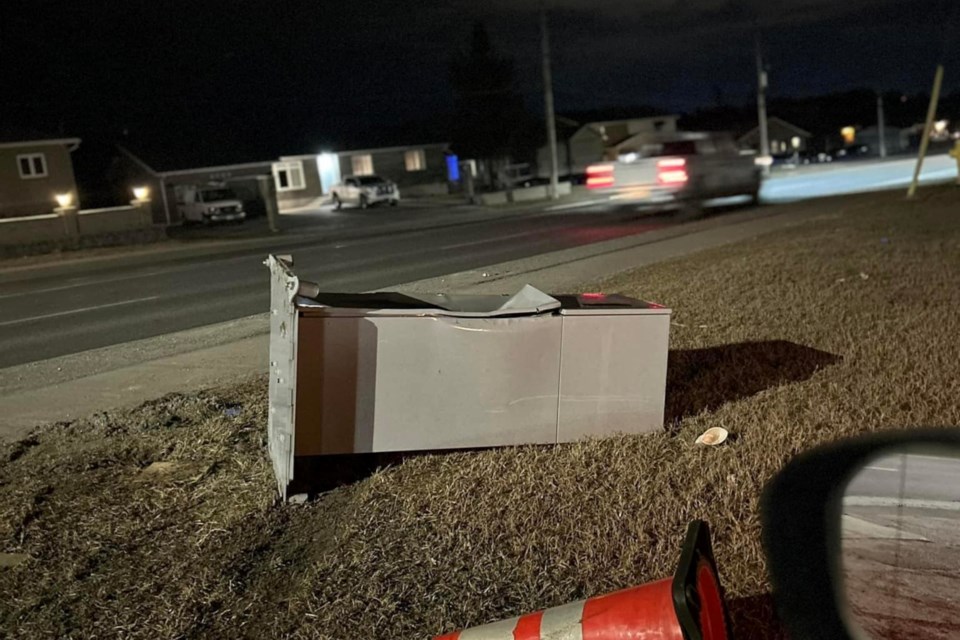
Not all have been so fortunate, and many have tried to exact their pound of flesh from decidedly fleshless (and bloodless) contraptions. To date we’ve heard of cameras being drowned, disemboweled, graffitied, knocked over and off their mortal coils and, after briefly meeting their makers, have been resurrected and returned (roughly three days later). They have been greased, glared at, swore at, and splattered with a wide array of obscuring agents.
They have also been obeyed.
“Fraud!” cried the maddened motorists and echo answered “Fraud!” But the rising tumult of traffic has indeed been becalmed in areas they have been stationed as if Mighty Casey himself had raised his hand.
With these cameras thusly perched, traffic has slowed to a curious crawl. While motorists’ may chafe and seethe inside their cars, outside them it’s like our neighbourhoods have been thrown back to simpler, safer times when automobiles were heavy, their brakes poor, and people actually drove slowly by choice so as to better extend the pleasurable and novel thing they found themselves seated in.
Compare this to today’s motorists: impatient, harried, engaged in a kind of grim and decidedly pleasureless form of driving, despite the modern automobile they’re in being far more refined and accommodating to their needs than a car of the 1950s ever could be.
Perhaps that’s because people in the year 2024 are, as a general rule, not happy. They’re also acutely aware of this unhappiness and they’re not happy about that, either. Perhaps it has something to do with the array of monitoring devices that let us know of every move we make and every smile we fake? You aren’t happy? That’s because you only had 57 minutes of REM sleep and were 503 steps under your goal.
It does seem a bit inconsistent of us to be self-monitoring the living daylights out of ourselves for our own personal good, while simultaneously chafing at any larger body doing the same for a larger, greater good. But people are touchy about their freedom these days.
Just how much freedom there even is to lose on our roadways is debatable as you watch vehicles making their way single file over lumpy, holey, sunken, dilapidated roads. For while the automobile has made significant advances, our highways and the repair of them, have not.
We still have five people (not the same five, though. Progress!) with shovels and hot asphalt filling in holes, probably much as they did in the earliest days of poor pavement. Given the state of most our roads, one must stop (or slow) and wonder why anybody would exceed the speed limit in this town?
But exceed it we sometimes do. As vigilant we try to be, we’ve all had occasional lapses where we’ve taken our mind off our speed and on the in-coming weekend, causing our right foot to press down a bit more than usual and the next thing we know we’re going over the posted limit.
When the awareness of your transgression hits you, it does so with a jolt. It is then we start asking ourselves panicked questions: Did the machine notice? Can it read a dirty plate? Can it read a dirty Doug Ford plate? Can it read a plate in the fog? Can it read a plate in the rain? Does it have half a brain? Do they like Pina Coladas?
None of these questions really matter. What matters is they work, and they work by impinging our freedom. As much as anybody with any self-interest will find it difficult to admit, sometimes impinging our individual freedoms improves our collective conditions. This is not an overly difficult concept to follow, but it does take self-sacrifice (you get where you’re going a bit later than you wanted) for a greater good (the neighbourhood, and not just its roadways, but its walkways too, are safer).
How you decide to answer the questions will depend on whether you’re a people pleaser or a person pleaser. You’re either looking out for No. 1, or all the numbers that come after it. Either way, the cameras will be watching.
D’Arcy Closs lives in Greater Sudbury. A rotating stable of community members share their thoughts on anything and everything, the only criteria being that it be thought-provoking. Got something on your mind to share with readers in Greater Sudbury? Climb aboard our Soapbox and have your say. Send material or pitches to [email protected].