

The lawyers who argued in support of the Robinson Huron Treaty legal team’s $510 million in fees are pushing back against the strong words contained in the Superior Court’s decision to slash them by $487 million, calling the judge’s findings “offensive” and “paternalistic.”
In an email to Sudbury.com on behalf of their clients, Nahwegahbow Corbiere, Brian Gover of Stockwoods Barristers said an appeal was being “contemplated,” and that it would “address the judge’s central findings” as well as “several negative inferences made about counsel.”
That’s a similar message to what Sudbury.com received from the Robinson Huron Treaty Litigation Team (RHTLF), which told us they are “conducting a full review of the decision” of Justice Frederick Myers, who wrote in his decision that legal fees are “not a lottery ticket offering a bonus prize of generational wealth to the lawyers.”
Disputing the judge’s characterization of their fees, Gover countered, saying far from a lottery ticket, “the massive case required the legal team to invest 17 years and 65,000 hours in a highly uncertain cause.”
According to a video featuring the man behind the Treaty annuities claim, Mike Restoule of the RHTLF, the settlement and specifically the decision have resulted in their nations “acting in colonial ways,” and “fighting and hurting each other over money.”
“This is tearing down our people,” he said. “Many are suffering.”
Nootchtai v. Nahwegahbow Corbiere


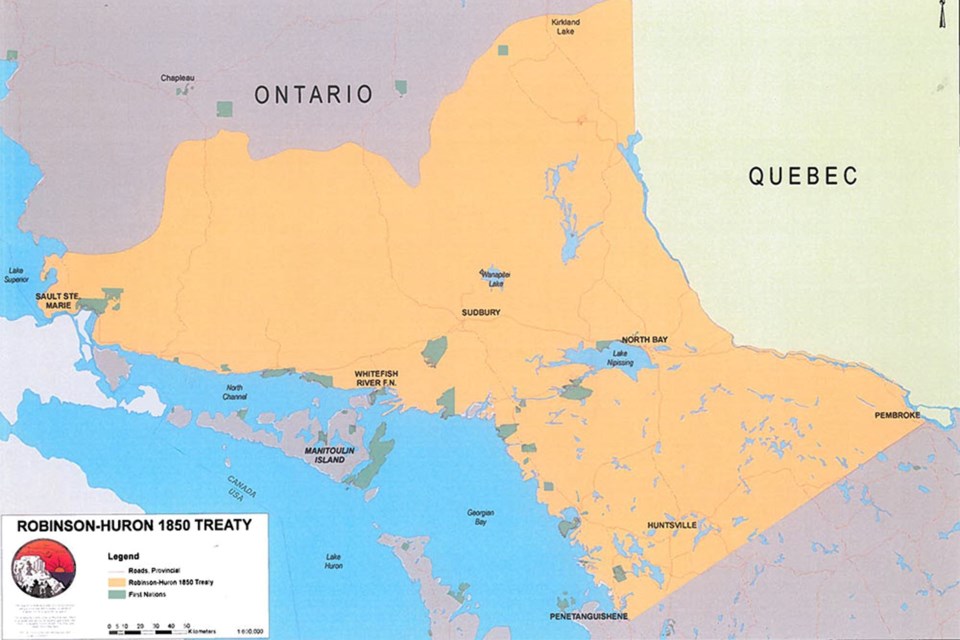
Myers' decision is the result of the challenge by two nations under the treaty, Garden River First Nation and Atikameksheng Anishnabek. In 2024, a judge agreed to reassess the $510 million in legal fees owed to the lawyers who negotiated the $10-billion Robinson Huron Treaty settlement, and the parties were to meet Sept. 29 through Oct. 3 to determine just what those fees should be.
On Oct. 29, the legal team found their bill would only come to $23 million, with Myers not just cutting their earnings, but admonishing two of the lawyers involved.
“Ontario Superior Court Justice Fred Myers’ decision flew in the face of the litigation fund’s firm belief that the legal team should be compensated in keeping with a fee structure that had been carefully negotiated,” said Gover, referring to the trust indenture, a contract binding the nations in their claim. “It also failed to recognize the central purpose of fee arrangements of the kind the client sought in this case, and that is to provide access to justice – which is why the First Nations retained the legal team.”
In the case that pitted two First Nations against 19 others under the treaty, it was also a battle between the recognition of Anishnaabe law, and attempts to fit it into a European-based legal system. The arguments came down to whether the fees were earned, based on signed contracts sanctified by Anishnaabe law, or if there is a clear conflict of interest that results in nations losing out on money they’re entitled to receive. You can find the full story of their arguments in court here.
Myers’ decision found that while the lawyers were to be paid 50 per cent of their legal fees along the way, they shifted the risk of the litigation to the First Nations, who ultimately paid 75 per cent of the legal fees and all disbursements throughout the case.
Many of the First Nations “took out interest-bearing loans arranged by the lawyers in order to pay the legal fees,” and because of that, the 21 First Nations paid their lawyers “more than $17 million in fees throughout the case, while the lawyers carried only $5.78 million in contingent (unpaid) time.”
Because they only carried the risk of just over $5 million, the letter states that Myers ruled the fees should only reach $23 million.
Through their own lawyers, Stockwood Barristers, Nahwegahbow Corbiere said the decision to slash their fee does not consider the risk the legal team took, the specialized skill and work load they took on, or the perpetual gift that is Treaty recognition: it means that treaty members can now negotiate the payments they receive going forward, and “the First Nations will benefit from the Legal Team’s work forever,” said Gover.
In his email to Sudbury.com, Gover got specific about the time invested in the case — 17 years and 65,000 hours — in a precedent-setting case.
“We strenuously disagree with Judge Myers’ conclusions about the risk involved,” writes Gover. “This litigation was enormously complicated and required arduous work by the entire legal team.”
He wrote that any suggestion that the First Nations negotiators were “naive or misled” is “offensive”.
“The Chiefs, Elders and other trustees involved in this agreement were experienced negotiators who drove a hard bargain and were well aware of what they were doing over the entire course of this ligation,” he wrote. “Unfortunately, Justice Myers’ decision continues a centuries-old narrative of First Nations being incapable of making informed decisions for themselves.”
In his submissions to the court, Gover said the chiefs of the 21 Robinson Huron First Nations knew what they wanted from counsel and evaluated proposals from six other law firms.
“These were not inexperienced and unsophisticated clients who lacked knowledge about retaining lawyers to advance their purposes,” said Gover.
Not only that, but at trial they argued that the legal team at Nahwegahbow Corbiere and the partial contingency fee they negotiated — a hybrid billing arrangement where the client pays some fees upfront and then pays a fee from the case winnings — offered access to justice the Robinson Huron nations would not have without it.
However, Myers’ wrote that the legal team of David Nahwegahbow and Diane Corbiere, through their actions, were “completely unaware of the difference between their personal interests and the client’s interests that they were duty bound to protect”, and that they were “discouraging their clients from obtaining independent legal advice on the fee and pressuring their clients to approve that fee.”
Not every fee structure is sanctified by a traditional pipe ceremony and for the RHTLF, that was enough, said Gover in his email. “They submitted that the traditional sense of honour and principle embedded in Anishnaabe culture demanded that the agreement be respected.
Judge Myers thought otherwise,” he wrote.
Gover said Myers “waved aside repeated assertions by the RHTLF that retaining independent counsel was considered at the time and was rejected as being unnecessary.”
“Judge Myers’ emphasis on the need for independent legal advice in such cases means that future litigants may feel compelled to automatically seek independent counsel,” Gover wrote. “This could damage the all-important relationship between lawyers and their clients.”
He also wrote that “appropriate legal fees were essential to attract lawyers who were prepared to risk almost 20 years of complex litigation against long odds.”
But in the end, Myers’ found in favour of Atikameksheng and Garden River and their submission, through attorney H. Michael Rosenberg, that a pipe ceremony is “about bringing people together, uniting them for a purpose; but the pipe ceremony cannot free anyone from their sacred obligation to continually reassess their needs and the needs of others, rather than blindly carrying out a bargain made in the past.”
Gover also expressed concern for the programming that would have resulted from the $255 million Nahwegahbow Corbiere would gift to the 21 First Nations involved, which would have represented half its fee for the work.
“It was to be used for a variety of programs and services that would enhance their way of life and the retention of the Anishnaabe language and culture,” he wrote. “In the wake of Judge Myers’ decision, it is far from clear how those planning commitments will be affected.”
Restoule’s message to the treaty members

Mike Restoule is the chair of the RHTLF Litigation Management Committee (LMC) which guides the legal team in their work.
In a video posted Nov. 1, he said there are “unfortunate and troubling realities occurring across the Robinson Huron territory,” and speaks to how some members have “resorted to criticism and derogation against fellow Anishinabek, and most particularly towards our chiefs and counselors —there are even threats of legal actions or overthrowing councils,” he said.
He says that in his experience with band chiefs and councils, “I have found them to be proud and dedicated Anishinaabek, who care about their people and their communities,” and that the “recent criticism and slander towards our leadership and the legal team are truly heartbreaking at a time when we need to stick up for each other to better our lives.”
Restoule then speaks of colonialism, defined as domination of a people or area by a foreign state or nation, or, in this case, the European domination of Indigenous people.
“Our history shows that we have suffered too much of that treatment at the hands of colonialism,” said Restoule, before stating he has heard treaty members “accusing leadership and the RHTLF of being controlled by, and putting onto our people, the colonial ways; however, that is far from the truth.
“Our own people are being influenced and acting in colonial ways, fighting and hurting each other over money,” said Restoule. “That’s not our way.
“Our ways have always been to take care of each other, each individual as one to contribute to the overall strength of our nation,” he said in the video. “We need to stay strong, proud and caring so that our children, grandchildren and future generations of Anishinabek can be proud of what we, their ancestors, did for them.
“It is my hope that we will be able to live in strong and caring communities, to be able to build a better foundation for a better life in our generations to come.”
Jenny Lamothe is a reporter for Sudbury.com