
Photo: arts image
Photo: dieter buse
Head:
Sub:
Culture exercises the mind and the emotions. In all the cultural realms which I touched upon in this series, I hope to have shown that Sudbury offers much to see, to think and to explore.
Sudbury was once the butt of a joke that asked: Which has more culture: yogurt or Sudbury? The implication was that Sudbury had none. I thought then, and am convinced now, that was a misconception.
Canada, including Sudbury, is rich in culture. The mixing, if not melding, of many languages and ethnic groups has offered opportunities for much variety to emerge in literature, theatre, visual arts and music. The diversity of people’s backgrounds has resulted in many modes of dress and regalia, often expressed in traditional ceremonial forms from kilts to ribbon dresses, gracing our public realm. Maintaining such activities also helps keep artistic crafts alive.
Further, as each immigrant group arrived, they built halls as their meeting places. In Sudbury, the numerous ethnic halls — whether Croatian, Finnish, Italian, Polish or Ukrainian — combined with union, legion, and service group halls have offered communities opportunities to express and maintain their culture even as their memberships were later diminished by demographic shifts.
Now many such halls serve a new purpose and provide space to other forms of cultural expression, including dancing and art exhibits.
Has Sudbury visual art in the form of painting, sketching, and printing not been enhanced by the exposure to a variety of global — at first mostly European — influences mixed with homegrown ones? For example, the well-known Group of Seven and their associate Tom Tomson, was beholden to European influences, since nearly all members spent time studying and living there.
Probably not so well known is that Sudbury has a large collection of these painters’ expressive and valuable works in its art gallery (eventually to be named for a member of the group, the Frank Carmichael Art Gallery of Sudbury), and that local visual artists, such as Nellie Keilor Lowe and Bruno Cavallo, worked closely with the group.
After all, it was our countryside from Sudbury to Algoma that the members helped make famous.
Aside: One day in the Group of Seven section of the Art Gallery of Ontario, I decided to do an experiment. School children from Toronto were trying to draw copies of the series of images representing, as stated by the room title, Algoma Country. I asked the children, aged about twelve to fourteen, where Algoma was. Not one knew. Can one conclude that Toronto may have much culture appropriated from other places but would benefit from more geographic knowledge to accompany it?
Through this series I have explored aspects of local culture. Immediately I must say that as a privileged person I have been to many of the major galleries and museums, the theatres and opera houses, especially in Europe and North America.
Hence, I believe that I can assert that what has been produced in Sudbury is not provincial in the sense of being narrow, but a worthwhile product expressing local talent and creativity. Though I researched and wrote this series as a member of the Sudbury Arts Council (after eight years, I left the board at the end of 2024), the opinions expressed were my own and based on my knowledge and experience.
Someone else might compose a quite different series of essays, especially since as an historian I included numerous historical asides and comparisons.
I see culture as providing many ways of expressing beauty, challenging perceived assumptions, and forcing reflection on or just appreciation of existence. For example, as an infrequent sculptor in soapstone, I can accept that beauty may simply be in an uncarved piece of rock, or it might be in the shape that is liberated by re-forming that stone with rasps and files.
Simply put: Poetic forms can be found outside of poetry and drama exists beyond the theatre.
Crafts such as pottery and wood carving overlap with sculpting as visual and public art forms. Hence, groups such as the Sudbury Basin Potters deserve a mention as do the many individuals who are not members of that group but practice on their own. In the series I did not address crafts, though beading or sewing or quilting can be seen as creative and imaginative cultural work.
A different but very strong cultural realm, resulting from the waves of immigration in Sudbury, is food and drink. Regarding drink, I think of the wine culture of local Italians with truckloads of grapes arriving in the autumn or as juice in plastic containers during much of the year.
Wine making at home in Sudbury may be decreasing but the tradition, which spread to other ethnic groups, recalls the ritual of crushing grapes, transferring and removing depot, cleaning demijohns and valves, bottling and waiting. Testing the product months later may not have found an excellent Amarone, but mostly very drinkable and low-cost vintages.
I personally benefitted from this local custom of self-created and community-encouraged cultural transfer. Ironically, some of my best was a German Riesling made with Francophone Canadian friends.
Immigrants also brought skills and traditions related to food. Like other urban peasants, I now make my own prosciutto and previously dried spice-laden sausages. The point is that what the first wave of immigrants did out of love for their food practices or necessity, they shared in their adopted communities. Why else do we have perogies or pula or kolbassa or so readily available locally?
Another form of food culture is the restaurant or place of restoration invented by the French in the late 18th century. In the last decade, the Sudbury restaurant scene has changed considerably, keeping pace with Canada’s larger urban centres. Korean, Vietnamese, diverse Indian and other cuisines have joined the longtime Italian, Chinese, so-called family restaurants and fast-food outlets.
Ironically, given Sudbury’s demographic makeup, no notable French bistro has emerged, though the Place des Arts has made a beginning.
I appreciated the comments and criticisms made about the individual essays, including those who privately and publicly informed me that they thought the articles “great.” Among the notable omissions were not mentioning Robert Masih teaching high-level dance at the YMCA. I admit to not knowing of Pierrie Chretien, a renowned jazz musician from Sudbury who founded Souljazz, though that group is identified with Ottawa.
I also missed the Connors family of singers and performers, in particular Eleanor Connors who founded the Sudbury Music Theatre which presented sold-out Gilbert and Sullivan operettas at the Sudbury Theatre Centre for more than 20 years.
When I reviewed historical writings about Sudbury, I should have mentioned Carl Wallace who did much to make local history the focus of research, for example, by directing students to write honours theses on historic buildings and urban issues. In addition, Dale Wilson dedicated himself to local railway history and his book Sudbury Electrics and Diesels demonstrated the importance of short run railways to the mining industry.
Regarding the Visual Arts, I did not know of the Full Circle Art gallery on Elm which shows and sells Indigenous art. On theatre, I was scolded for not giving more attention to the achievements of Yes Theatre; on film I was applauded for the thorough coverage. My apologies for whatever I overlooked, and I welcome comments to [email protected].
In concluding my series demonstrating the great variety and high quality of Sudbury’s cultural scene I would like to thank the individuals who reviewed and commented on drafts. Usually, two persons who work in or are informed on the cultural areas I covered, reviewed one of my drafts. Since I have not asked their permission, I do not provide their names. The results are, as usual, my own responsibility.
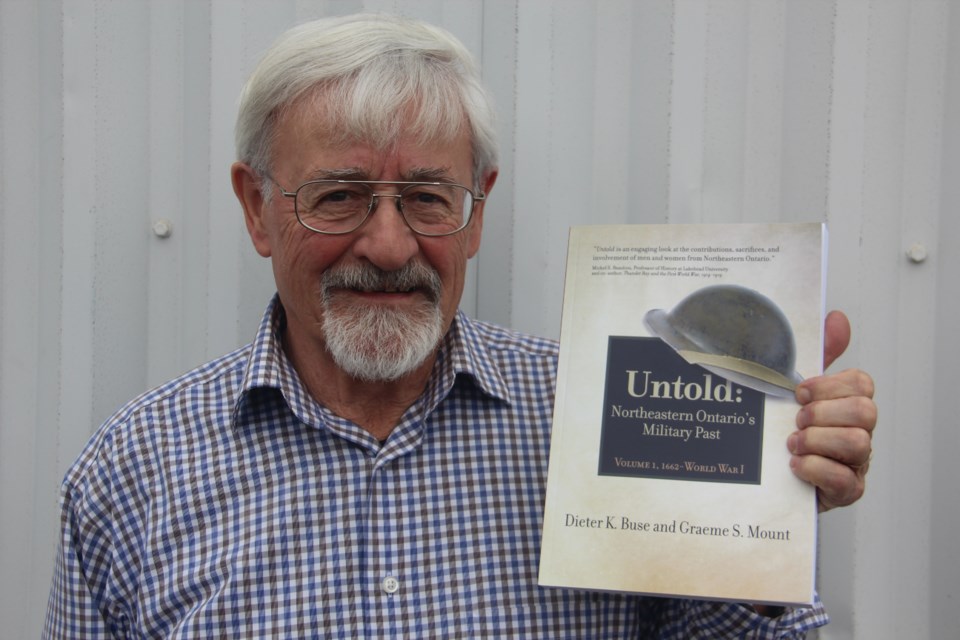
Dr. Dieter K. Buse is professor emeritus, History, Laurentian University, and a failed trumpet and banjo player. He is writing a series of columns on local culture and history on behalf of the Sudbury Arts Council.