
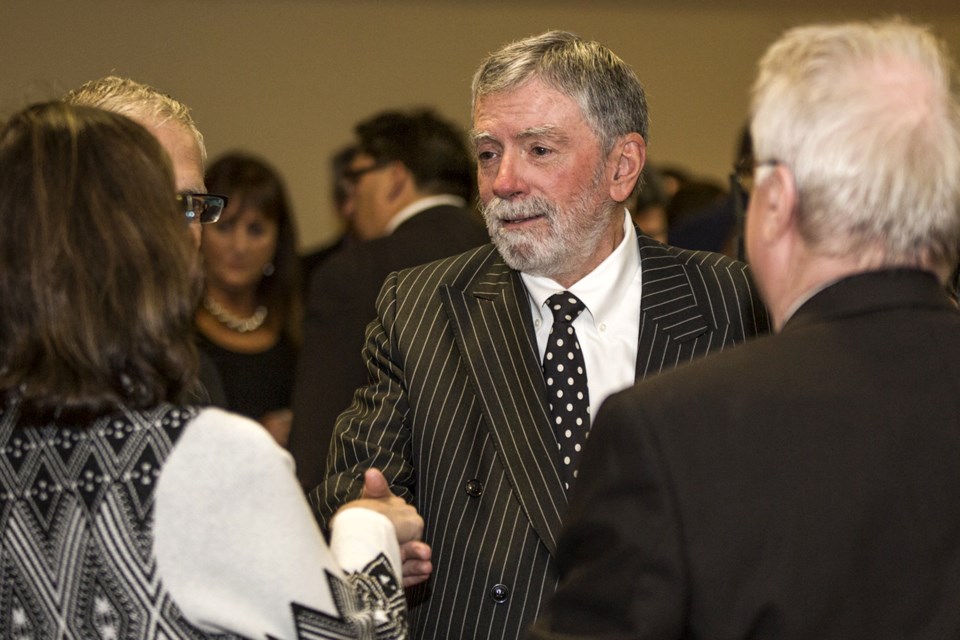
Mike Atkins was a transformational leader and a complete friend in the Aristotelian sense.
This essay is not designed to mourn the passing of an exceptional achiever in Canada but to celebrate the life of a person who enriched our lives with his presence.
Our lives are primarily constituted by the Three Ps: Personal, Professional and Public.
Others have spoken and written about his personal life as a family person and his professional life as a media mogul. It is an honour to speak about his public life. For giving me the opportunity to do so I am thankful to all those who made this possible.
One of the great poets in English, Alfred Lord Tennyson, wrote in the much celebrated poem “Ulysses”:
The lights begin to twinkle from the rocks:
The long day wanes: the slow moon climbs: The deep
Moans round with many voices. Come, my friends,
’Tis not too late to seek a newer world.
Mike was always seeking a newer and better world for Northern Ontario and Canada. Transactional leaders leave their own footprints on the sands of time. Transformational leaders enable others to leave their footprints on the sands of time.
Mike was one of those transformational leaders who empowered others to self-actualize themselves and leave their footprints. It is a testament to Mike’s transformational skills that those whom he empowered do not even know that it was Mike who made them into who they became.
With rare exceptions, most of them think that they deserved what came their way — the true mark of a transformational leader.
It has been said that the Golden Age of Sudbury lasted from 1973 through 1985. Golden ages in a city or a nation are the product of a confluence of events and a critical mass of “Culture
Creatives” who seize the moment and usher in the Golden Age.
Events included massive environmental degradation, decline in mining employment and the creation of the city-state regional government. Culture Creatives included a significant number of people in a multiplicity of fields who desired to create a future in their image untrammelled by the past.
Mike’s signal achievement consisted of assembling, nurturing and unleashing a coalition of culture creatives to transform the mindscape of Sudbury. Let me state it better. The latent talents of Culture Creatives found a fuller expression in the coalition of change agents who went on to light the torch of the Golden Age. Other people built upon the multi-partite initiative first created by Mike in 1977 and cemented the gains made.
They deserve to be acknowledged and commended. What is indisputable, however, is that the very idea of multi-partite efforts was invented by Mike. The Greater Sudbury area is a better community because of that. That is transformative leadership.
President John F. Kennedy said that a nation is known by not only the kind of people it produces but also the kind of people it honours and remembers. In this spirit, Mike initiated the honouring of leaders of business in Northern Ontario in 1986 and community leaders of Sudbury in 2002.
Awards of excellence represent not only a recognition of individuals and institutions involved but also a mirror of ourselves. By recognizing outstanding achievement amidst us we partake of their achievement, for sure.
More importantly, however, we tell ourselves and the world the kind of people we are. Mike made this possible through the creation of the awards programs.
In the great book of Western Civilization “Nicomachean Ethics”, Aristotle identifies 11 moral virtues and devotes two out of the 10 books to friendship.
At the very beginning, he posits that friendship is essential for living well and contends that even if a person had all other goods no one would wish to live without friends. He goes on to pinpoint the five distinguishing attributes of friendship: (1) A friend wishes for and does what appears good for the other person’s sake; (2) A friend wishes for his friend to exist and live for the friend’s sake; (3) Friends go through life together; (4) They choose the same things, and; (5) They share in sufferings and joys.
Even a minimal reflection on these attributes demonstrates that these are demanding requirements.
Is it any wonder that this constellation of pentagonal attributes are so rare that we call our acquaintances who do not display any of these attributes as our friends? We do this not because we are lax with usage of words, but because we wish our acquaintances to become our friends in the Aristotelian sense. Alas, our wish is rarely, if ever, fulfilled.
One of my greatest satisfactions in life was that Mike was my friend. Permit me to explain.
Mike and I met for the first time in December 1975 on a planning document. People who have known us in Ontario are aware that we were friends in the truest sense of the term.
As is well-known, friendship is of three main kinds; namely, the useful, the pleasant, and the virtuous, and each kind embodies reciprocal love that is clearly acknowledged. All of us are familiar with the first two kinds, the useful and the pleasant. Mike and I had those two kinds of friendship, for sure.
What was unique about our friendship was that we had the third kind of friendship that depends entirely upon the good character of friends. Friendship anchored in virtue is straightforward as long as the baggage associated with the word virtue is set aside. It means that we do things simply because they are the right things to do.
Both of us, like most Canadians, are pragmatic people. We distinguished between doing it right and doing the right thing. On simple matters, we tried to do it right but on complex matters we anguished over doing the right thing. Our agonized search led to profound differences because they were embedded in a conflict of visions.
In our tormented explorations, Mike was the beacon that illuminated the path. Once we agreed on the chosen path, there was no further debate notwithstanding whatever remnant reservations we entertained over the chosen path. Loyalty mattered and without that we could not have possibly remained as Aristotelian complete friends.
Many readers of this essay in their sessions of sweet silent thought as Shakespeare put it, would acknowledge that they too have experienced intimations of this complete friendship with Mike. In stating this I am merely codifying common knowledge and experience.
We shall miss him. And yet, we will not miss him for he lives in our hearts through his ideas and ideals. His spirit shall live as long as people value public service and friendship.
As the wisdom saying from all great civilizations of the past intones, this loss and grief too shall pass. It will be supplanted by the flame of the spirit of Mike that fuels it.
Narasim Katary is the former director of long-range planning with the then Regional Municipality of Sudbury (now the City of Greater Sudbury, COGS,1975 - 1989) and, along with Michael Atkins, was part of the Sudbury 2001 group that envisioned ways of diversifying the city’s mining economy in the 1980s. His is also a lifelong friend of Mr. Atkins.