

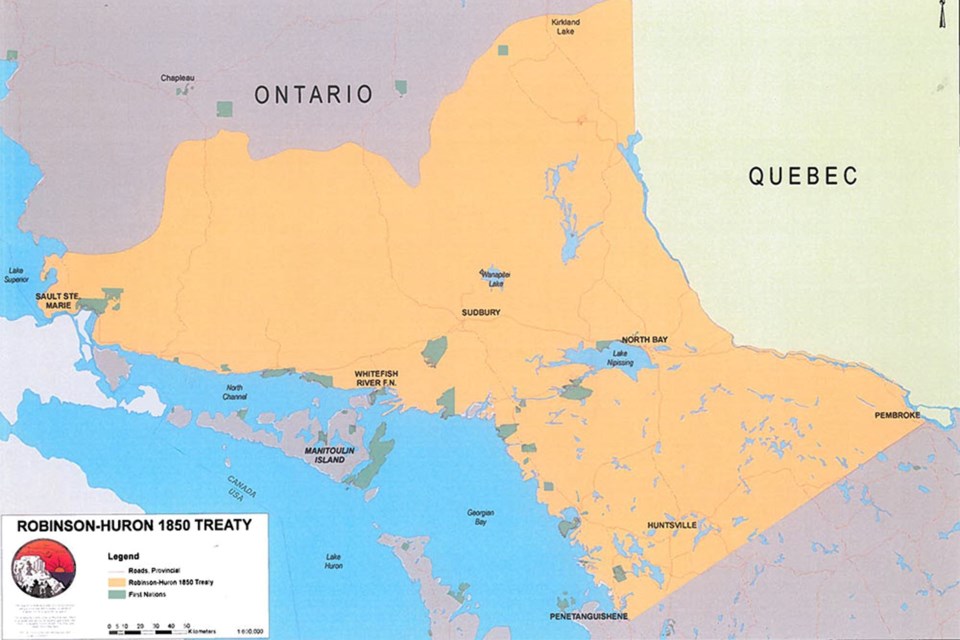
A judge has slashed the $510 million in fees set to be paid to the legal team behind the $10 billion Robinson Huron Treaty settlement, ordering them reduced to $23 million.
The decision is the result of the challenge by two nations under the treaty, Garden River First Nation and Atikameksheng Anishnabek, whose counsel argued the case before Ontario Superior Court Justice Frederick Myers Sept. 29 through Oct. 3.
For a detailed review of the legal arguments in the case, see Sudbury.com’s story here.
The decision has not yet been made public, but Atikameksheng Anishnawbek published a letter to their community about the fee change, and the confidential documents were provided to Sudbury.com.
Dated Oct. 28, the letter begins by stating the two First Nations successfully challenged the fees, with Myers “finding that the partial contingency fee agreement and the legal fees charged under it were unfair and unreasonable” and ordering a reduction of $487 million.
The letter, on official letterhead with a watermark that reads “confidential” continues with a review of the case itself, beginning with the 2023 annuities case settlement of $10 billion.
“The fee relationship between the lawyer and the First Nations was governed by a partial contingency agreement,” the letter states. “While the lawyers were to be paid 50 per cent of their legal fees along the way, they shifted the risk of the litigation to the First Nations, who ultimately paid 75 per cent of the legal fees and all disbursements throughout the case.”
The letter tells members that many of the First Nations “took out interest-bearing loans arranged by the lawyers in order to pay the legal fees,” and because of that, the 21 First Nations paid their lawyers “more than $17 million in fees throughout the case, while the lawyers carried only $5.78 million in contingent (unpaid) time.”
Because they only carried the risk of just over $5 million, the letter states that Myers ruled the fees should only reach $23 million.
“He explained that the $10 billion outcome of the litigation ‘belongs to the clients’ and that ‘a lawyer’s professional retainer is not a lottery ticket offering a bonus prize of generational wealth to the lawyers.”
The Atikameksheng letter states that Myers “criticized the lawyers for acting as though they were ‘completely unaware of the difference between their personal interests and the client’s interests that they were duty bound to protect’, as well as “discouraging their clients from obtaining independent legal advice on the fee and pressuring their clients to approve that fee.”
The letter also states that Myers expressed concerns about the conduct of two of the Robinson Huron lawyers, Diane Corbiere and David Nahwegahbow.
Atikameksheng attributes to Myers’ decision that Corebiere "twice gave advice to her clients that was simply incorrect expressly to pressure them to recognize her fees without obtaining independent legal advice” and “implored her clients as ‘family’...to play on their honour without ensuring that they understood that the assessment of legal fees is both honourable under the applicable Ontario law and is expressly preserved in the contingency-fee structure.”
Of Nahwegahbow, Atikamsheng’s letter states Myer said he “provided advice on the $510 million fee that was ‘incorrect and self-interested’ despite acknowledging he was in a conflict of interest when doing so.”
The letter states that these circumstances resulted in the Robinson Huron Treaty Litigation Fund (RHTLF) being overcharged $487 million in legal fees.
“These funds will be returned to the RHTLF and are expected to result in millions of dollars being distributed to each of the 21 First Nations” of the Robinson Huron Treaty, states the letter.
Jenny Lamothe covers vulnerable and marginalized populations, as well as housing issues and the justice system for Sudbury.com.