

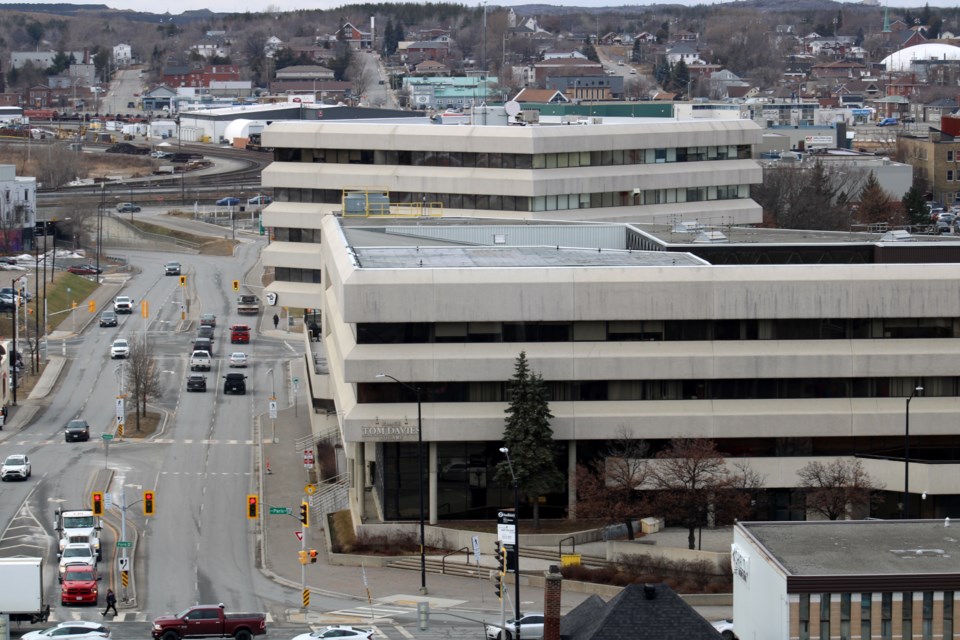
The City of Greater Sudbury’s draft budget for 2026-27 won’t be released until Nov. 4, but much is already known about it due to city council having set a number of directions.
The draft budget is a staff-drafted budget which follows city council direction but has yet to be approved by the city’s elected officials. That’s anticipated to take place in December.
Per city council decisions made in June, the draft budget will include a 4.8-per-cent water/wastewater rate increase.
Following the city’s council-approved long-range financial plan, the tax levy increase within the draft budget is anticipated to fit within the 3.2- to 4.4-per-cent range.
Earlier this month, the Greater Sudbury Police Service board unanimously approved a 2026 budget hike of 12.66 per cent.
Shortly after the police board’s budget approval, Ward 9 Coun. (and city finance and administration committee chair) Deb McIntosh tabled a successful motion for staff to prepare a report outlining city council’s “roles, responsibilities and authority in relation to the approval or disapproval of the service partners’ proposed budgets” to be presented on Nov. 12.
This report will pre-empt the GSPS’s budget presentation and set the stage by clarifying city council’s limited role in determining the police budget. It’s anticipated to explain that city council members’ vote is limited to yea or nay on GSPS’s proposed operating budget expenditure totals of $94,062,209 in 2026 and $102,160,358 in 2027.
In the event both sides disagree and stick to their guns, the budget will be sent to the Ontario Civilian Police Commission for a final decision.
Conservation Sudbury and the Greater Sudbury Public Library Board will also present their budgets on Nov. 12, while Public Health Sudbury and Districts will present their budget on Nov. 25.
Budget deliberations will begin on Dec. 2 and feature up to at least 32 business cases which each propose changing municipal service levels. Only those business cases members of council choose to champion will be debated for consideration as part of the budget process.
With various business cases yet to be drafted as of the latest update, the tentative total 2026 budget impact associated with adopting all of them is $3.7 million. None of these business cases will be baked into the base budget tabled on Nov. 4, meaning they’d alter the tax levy total if adopted.
Each one-per cent change in the tax levy represents approximately $3.3 million in expenditure.
Adopting all 32 business cases would entail hiring at least 12 additional staff members, including four firefighters and two additional mechanical officers for Greater Sudbury Fire Services.
The proposed addition of four firefighters extends from 2024 budget deliberations, during which Greater Sudbury Fire Services sought eight additional firefighters to address chronic staff shortages, but city council members only granted four.
“Daily absences — averaging seven per day due to vacation, sick leave, WSIB claims and retirements — continue to strain operations, making overtime a daily necessity to meet the collective bargaining agreement’s minimum staffing requirement,” according to the business case. “This business case seeks to complete the second phase of this plan to stabilize staffing levels, reduce overtime reliance and maintain essential emergency response capacity.”
During a finance and administration committee meeting of city council earlier this month, the city’s elected officials voted to forward all 32 business cases to budget deliberations.
This doesn’t necessarily signal support, but that they’ll be up for consideration. In December, only those business cases a city council member has opted to champion will be debated.
Business cases are as follows, with associated 2026 budget impacts where available or applicable. In the case of hires, they’re oftentimes mid-year, with subsequent years more costly.
In the case of $187,567 for four additional firefighters as an example, the expenditure jumps to $325,074 in 2027. Meanwhile, these estimates are net an anticipated overtime reduction of $394,000, with total salaries and benefits for the four positions totalling $719,074 in 2026.
- Implement Permanent Mobile Security Enforcement Team for Housing Operations ($320,748)
- Hire Housing Security Control Operator ($300,000)
- Hire Two Additional Mechanical Officers for Fire Services ($233,925)
- Update Parks, Open Space and Leisure Master Plan ($225,000)
- Hire Additional Health and Safety Advisor ($140,088)
- Hire Additional Driver Certification Instructor ($134,308)
- Enhance Corporate Security Operations Software ($86,895)
- Enhance Hazardous Medication Safety
- Increase On-Deck Supervision During Group Swimming Lessons
- Create Full-Time Senior Accountant Role
- Hire Digital Content Specialist
- Install New Exterior Columbarium Wall at St. Joseph’s Cemetery in Chelmsford
- Implement 2026-2027 Sustainable Waste Strategies ($725,210)
- Hire Four Additional Firefighters ($187,597)
- Develop a Playground in Wanup ($162,000)
- Implement Yellow Box Non-Residential Recycling Program ($95,186)
- Increase Service Level to GOVA Route 106 ($32,175)
- Implement an Advanced Care Paramedic Training and Education Program ($30,000)
- Hire a Paramedic Wellness Co-ordinator
- Upgrade Belisle Drive Water/Wastewater Infrastructure
- Demolish Sudbury Community Arena
- Develop Indigenous-led Transitional Housing with Wrap-round Supports
- Develop Youth Transitional Housing Program with Emergency Shelter Beds
- Enhance Kalmo Beach Accessibility
- Enhance Winter Sidewalk Maintenance
- Vacate and Dispose of Edison Building
- Proceed with Phase 2 of MR 55 Lorne Street Infrastructure Renewal ($974,647)
- Install Road Weather Information Stations ($305,000)
- Hire a Road Safety Analyst
- Create an Outdoor Sports Court at O'Connor Playground
- Eliminate Driveway Entrance Culvert Subsidy (savings of $219,367)
One business case to stick out, which has not yet been drafted by city staff, is “demolish Sudbury Community Arena.” Per city council direction, the arena would only be torn down if a private investor does not come forward with a plan to repurpose the building by the time the new municipal event centre opens in 2028. Earlier this year, the old arena’s demolition was estimated to cost approximately $5 million.
During a finance and administration committee meeting of city council earlier this month, Ward 3 Coun. Michel Brabant successfully tacked on business case No. 32, which requests direct GOVA Transit service to the St. Gabriel's Villa of Sudbury long-term care centre in Chelmsford.
City council members will debate the budget, including business cases, beginning on Dec. 2, and are anticipated to approve a 2026-27 operating budget and readopt the two remaining years of the 2024-27 capital budget by Dec. 4.
The 2026 property tax policy, which calculates how the tax levy burden is distributed amongst property classes, is scheduled to be approved by May 2026.
Tyler Clarke covers city hall and political affairs for Sudbury.com.